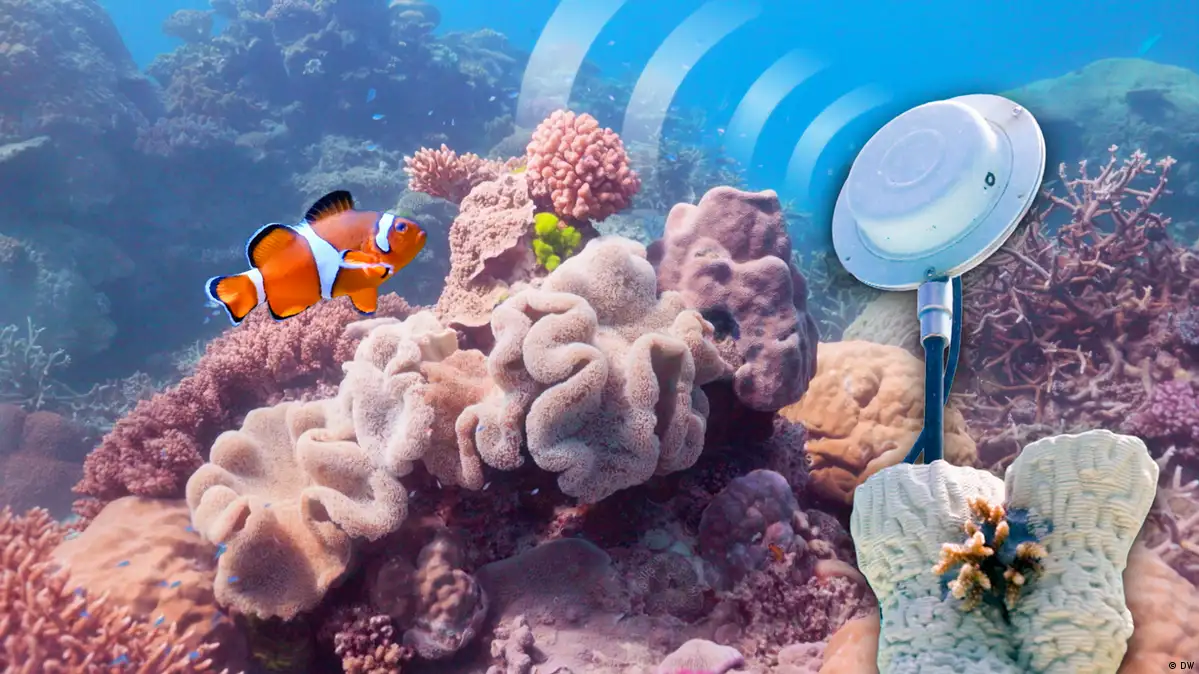
Climate change and pollution are devastating coral reefs worldwide. Artist Marco Barotti has an unusual idea for bringing life back to dead reefs: 3D-printed sculptures and sound.
Advertisement
Coral reefs are among the most biodiverse ecosystems on Earth. Although they cover less than 1% of the ocean floor, they provide a habitat for around a quarter of all marine species. At the same time, they provide food, income and coastal protection for millions of people. But climate change, marine heatwaves, overfishing and pollution are putting these fragile ecosystems under enormous pressure. Experts warn that around 90% of coral reefs could be destroyed by 2050.
Media artist Marco Barotti is therefore taking an unusual approach: Using artificial, 3D-printed reefs and speakers, he plays the sounds of healthy coral reefs underwater. The idea is that many marine species use these soundscapes to find their way around. Studies show that the sounds of healthy reefs can attract fish and encourage marine life to return to damaged habitats. This form of sound therapy cannot stop climate change, but it could help coral reefs recover more quickly and attract new inhabitants.
Scientists warn that rising global temperatures have pushed the world's coral reefs to a likely point of no return. Can they be brought back from the brink?
Image: Norbert Probst/imagebroker/imago images
Tipping point for coral reached
Earth has for the first time hit a "tipping point" — a climate limit, which if passed can trigger massive, abrupt and irreversible change. Rising ocean temperatures are causing mass deaths of warm-water coral reefs, scientists at the United Kingdom's University of Exeter found. Global warming needs to be reduced to 1 degree Celsius (1.8 F) above the preindustrial average to avoid permanent loss.
Image: Great Barrier Reef Foundation/dpa/picture alliance
One of world's most biodiverse ecosystems
Scientists warn that the loss of coral reefs would be a tragedy for nature and the people who rely on them. Corals are invertebrate animals found in the oceans around 100 countries. They support a quarter of all marine life and provide a habitat for more than 800,000 species. Nearly 1 billion people depend on them directly for food or generating income.
Image: J. Sumerling/AP/dpa/picture alliance
Marine heat waves increasing
According to the report, 1.2 degrees Celsius warming is the critical threshold for coral to survive. The world has now hit about 1.4 C above preindustrial levels. In addition to rising average ocean temperatures, reefs are also facing more intense and frequent marine heat waves. These are pushing the small, colorful underwater creatures beyond their survival limits.
Image: David Gray/AFP/Getty Images
Unprecedented bleaching event
Increased ocean temperatures are the main cause of coral bleaching, which happens when corals expel the symbiotic algae living in their tissues. This causes them to turn white and — if it happens over longer periods — die. Over the past two years, more than 80% of the world's reefs in more than 80 countries have suffered the worst bleaching event on record.
Image: Grace Frank/Australian Institute of Marine Science/REUTERS
Heat-resistant coral
Despite the report's severe findings, scientists say pockets of reef may survive and should continue to be protected. Some evidence suggests that certain corals may be better able to adapt to warming. On the northern shores of the Red Sea, species with a high tolerance to heat stress are being crossbred with other corals to see if it increases their resilience.
Image: Alex Mustard/Nature Picture Library/imago images
Nursing transplanted corals back to health
Projects around the world, such as the one pictured here in Florida, are attempting to grow coral in nurseries and then place it back into reefs. In Goa, teams are collecting broken coral fragments and fixing them to large tiles with epoxy underwater to see how well they grow. They hope to reveal which species might be able to recover from bleaching and thrive in other parts of the world.
Image: Wilfredo Lee/AP Photo/picture alliance
Using sound to protect coral
On the island of La Reunion in the Indian Ocean, researchers are placing underwater microphones close to coral to record their sounds. The resulting audio maps could reveal which parts of the reef need protection and times when shipping and tourism should be scaled back, such as when fish are spawning.
Image: DW
Tackling nonclimate threats
The Exeter University report also notes that more can be done to tackle drivers of coral degradation that are not linked to climate change. Solutions include expanding marine protected areas, regulating coastal development, curbing overfishing and decreasing agricultural pollution that runs off into the water.
Image: PantherMedia/picture alliance
Emissions cuts are crucial
Ultimately, scientists say, unless the planet cools, these vital marine ecosystems will be lost. They say rapid and deep cuts to greenhouse gas emissions are crucial to bringing coral reefs back from the brink. The report's authors write that the tipping point should be a wake-up call for leaders heading to the UN climate summit in Brazil in November.