Quadriga - Super Poll - Europe Has Its Say
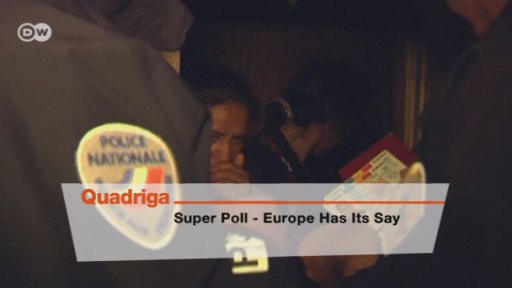
This browser does not support the video element.
The European parliament is the only EU institution whose members are directly elected by the citizens of member states. For the first time in the parliament's history, the main party-blocs have sent leading candidates into the fray. In recent years the parliament's powers have grow, and the holders of some of the most important posts in the EU are due to be decided after the election. Yet despite the importance of the vote for Brussels, polls show that few voters plan to turn out and cast their ballots.
Europe has been grappling with the euro crisis and massive sovereign debt for half a decade now. New mechanisms are being set up to deal with future economic shocks, but years of austerity in several EU countries have led to animosity. In more stable economies, there's a feeling that too much money has been used to bail out bankrupt Member States. In countries hit hard by the crisis, living standards have fallen and joblessness risen as a result of saving insolvent banks. Income differences between northern and southern Europe have grown more marked, while extremely high youth unemployment figures in Spain, Greece and Italy have discouraged an entire generation. In the eyes of many of its citizens, the EU no longer provides a guarantee of prosperity.
That has led to questions over the EU's relevance. Is there a common "Europe"? Should the continent be a fortress, or a place where immigrants are welcomed? Why are right-wing and eurosceptic parties gaining popularity in some EU countries at the cost of established parties? Why are they apparently able to mobilize more passion against the EU than established parties can muster in favor of it? How can Europe win back its citizens’ trust?
"Super Poll - Europe has its say" - Let us know what you think: quadriga@dw.de
Eastern Enlargement - Big EU, Big Success?
Our guests:
Stefano Casertano – He is the correspondent for the italian newspaper Pagina 99 in Berlin. He also taught international politics at Potsdam University, and was a Senior Fellow at the Brandenburg Institute for Society and Security. He served as international affairs advisor for the Italian Ministry of Economic Development and published four books about geopolitics, starting with a History of Cold War in 2009. In 2010, he has been nominated "Italian Young Leader" by the US-Italy council; and "Aspen Young Fellow" by the Aspen Institute.
David Charter – He is the Berlin Correspondent of the British newspaper The Times. He has worked at the newspaper in various roles including Chief Political Correspondent from 2001-2006. After that he served as the newspapers´ EU-Correspondent in Brussels for five years. Last year [2012], he published his book "Au Revoir Europe: What if Britain left the EU?".
Ulrike Guérot is a journalist, essayist and analyst who currently heads the Open Society Initiative for Europe (OSIFE), which focuses on the future of European democracy. She was a former Berlin bureau chief for the European Council on Foreign Relations, and has also worked with the German Marshall Fund and the German Council on Foreign Relations. Her areas of expertise include the European integration process, German-French ties and German-American relations. For her engagement on European integration, Guérot was recently awarded the prestigious ‘Ordre pour le Merite’.