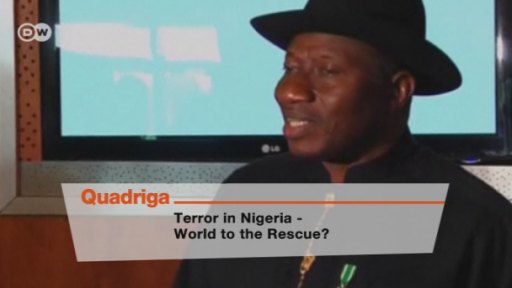
Quadriga - Terror in Nigeria - World to the Rescue?
This browser does not support the video element.
The call to #BringBackOurGirls has echoed around the world through social media. Several prominent people outside Nigeria, including US First Lady Michele Obama, are supporting the online campaign. Israel, France, China, the US and Britain have offered military support in the form of advisors or equipment to the Nigerian government to find the girls.
Nigeria’s President Goodluck Jonathan has taken up that offer. He’s been sharply criticized by Nigerians for failing to act quickly to the kidnapping but some observers are questioning whether it’s right to accept military aid. They say the #BringBackOurGirls campaign could open the door to foreign interference in Nigeria’s affairs. It may also give the terror group Boko Haram precisely what it is seeking: publicity for its cause.
Boko Haram’s leader, Abubakar Shekau, has offered to exchange the girls for Islamist insurgents held by the Nigerian authorities. His group is mainly active in the majority Muslim north east of Nigeria. In contrast to the oil-rich southern Christian part of the country, the north east is one of the poorest regions in the world. Boko Haram has been fighting an insurgent struggle against what it says are western values and for an Islamic state. Thousands of people have been killed in their bloody campaign and according to the UN over a quarter of a million Nigerians have had to flee the fighting.
Can the outcry abroad help Nigeria’s government find the girls? Will foreign help do anything to end the Islamist insurgency in Nigeria?
Tell us what your opinion is: Terror in Nigeria - World to the Rescue?
quadriga@dw.de
Eastern Enlargement - Big EU, Big Success?
Our guests:
Peter Dörrie - studied Geographical Development Research with a focus on Africa in Bayreuth, Germany and International Politics and Security Studies in Bradford, UK. He has worked as a freelance journalist, covering resource politics and security issues in Africa for publications like War is Boring, Welt-Sichten and Think Africa Press.
John Emeka Akude – studied International Relations in his home country, Nigeria, before moving to Germany to study at the University of Cologne. He has lectured at the Institute for African Studies at the University of Cologne and was an advisor at Germany’s Ministry for Economic Cooperation and Development. He is a researcher at the German Development institute where his focus is on conflict and conflict management in Africa as well as Africa’s role in international relations.
Zainab Ahmed Mohamed - is a journalist with Deutsche Welle’s Africa Desk. She is a coordinator for the "Learning by Ear Programme" which deals with issues that are in the forefront of the African news discourse such as, corruption, girl-child education, politics and other social issues that affect the lives of youth in Africa.