Quadriga
This browser does not support the video element.
Much is at stake ahead of the first round of the French Presidential election this Sunday - for both France and Europe, if the candidates are to be believed. Rarely has Europe played such a key role in a French election campaign. The Socialist challenger Francois Hollande wants to promote growth, invest public money to create jobs and improve the education system. He says he will raise taxes to finance his plans. He also wants to renegotiate the fiscal pact aimed at making it harder for European countries to run up debts. President Sarkozy, however, wants to keep the pact as it is. But Sarkozy has also made provocative statements on Europe.
At a campaign rally this weekend he stepped up his demand to give the European Central Bank, the ECB a bigger role in promoting growth. Up to now the role of the ECB has been to maintain stability. He also wants to improve French competitiveness through a "Buy European Act". And he is calling for a tightening of the Schengen agreement on EU open borders and threatening to withdraw from the pact unless fellow members do more to control immigration from outside the EU.
The criticism of Europe from France is worrying the country's European partners. The German Chancellor, Angela Merkel needs Sarkozy as strong and consistent partner in the Euro Crisis. But since the campaign has started in earnest, Sarkozy, her most important ally, has begun rejecting Merkel's advances.
Surveys put Hollande in the lead. Even Sarkozy's supporters think their man is going to lose. Two thirds of voters who said they would vote for Hollande said they were voting against Sarkozy.
So is this all political posturing or is France about to redefine its national identity? Will the French elections change the balance of power in Europe? Is the vote in France a vote on the future of Europe?
Tell us what you think: Election Time in France - All Change for Europe? Write to us at Quadriga@dw.de
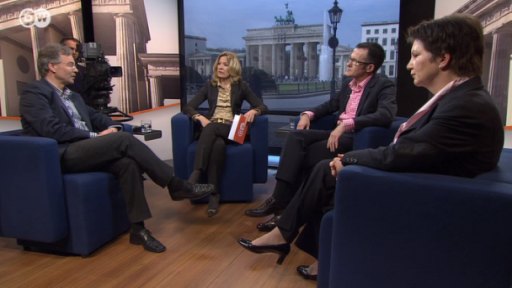
The guests of the show are:
Pascal Thibaut - The French journalist came to Berlin in 1990 and initially worked as a freelance journalist for various media organisations, including Radio Multi Kulti and Deutschland Radio. Since 1997 he has been foreign correspondent for Radio France International. Since 2008 Thibaut’s coverage has focussed on the European debt crisis and the way this has changed the roles of France and Germany.
Albrecht Meier - He was trained at the "Neue Osnabrücker Zeitung" and subsequently worked as a local reporter for the "Taunus-Zeitung" in Bad Homburg (in Hessen). After completing his studies in Politics and Modern History, he came to Berlin where he became a Political Editor of the newspaper "Der Tagesspiegel" in 1991. He writes mainly about EU politics, France and Great Britain.
Ursula Weidenfeld - has a PhD in history from the University of Bonn and studied journalism at the Holtzbrinck School in Düsseldorf. She became Berlin correspondent and a deputy editor at Wirtschaftswoche, before going on to head the corporations desk at the Financial Times Deutschland. In 2001 she became economics editor at Der Tagesspiegel in Berlin. Ms Weidenfeld has also worked as a presenter and commentator for various TV and radio stations. In 2008 she became editor of the Cologne-based business magazine Impulse and was awarded the Ludwig Erhard prize for business journalism. Ms Weidenfeld is now a freelance journalist. Published this year, her latest book "Gelduntergang" ( or The Fall of Money) discusses the long-term effects of the debt crisis on the Euro and the significance of a stability culture which appears to be increasingly irelevant for ever more countries.